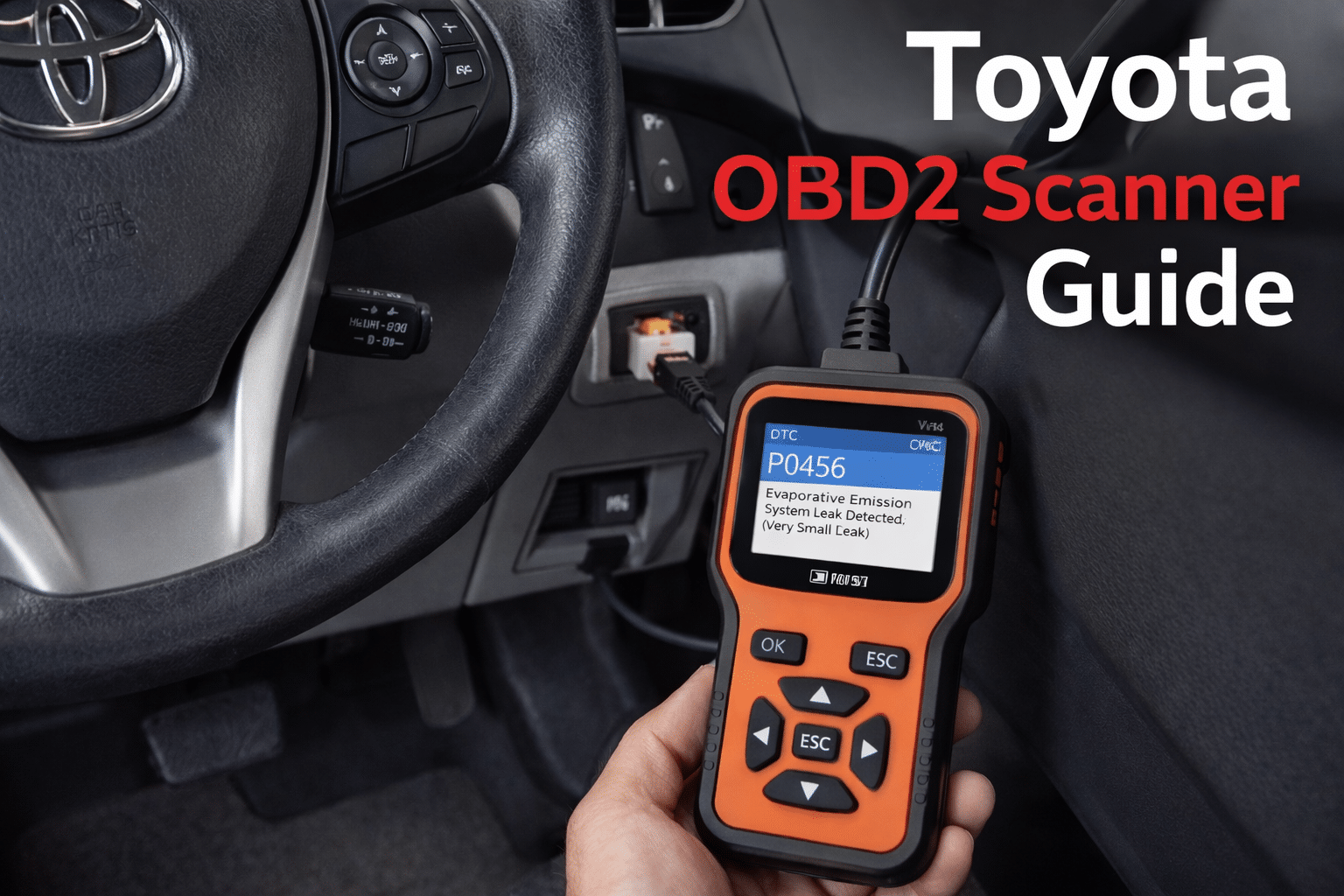
If your Toyota’s check engine light suddenly turns on, a Toyota OBD2 scanner can help you identify the problem before visiting a mechanic.
This guide explains how a Toyota OBD2 scanner works, common trouble codes, and how to use one safely at home.
______________________________________________________________________________________________________________________________________
What Is a Toyota OBD2 Scanner?
OBD2 (On-Board Diagnostics II) is a vehicle diagnostic system required in vehicles sold in the United States since 1996. The OBD-II standard is now used globally to monitor vehicle performance and emissions systems. You can read a more detailed technical overview on Wikipedia’s On-Board Diagnostics page.
OBD2 systems are designed to monitor emissions-related components and alert drivers when a malfunction is detected.
Toyota vehicles such as the Corolla, Camry, RAV4, Tacoma, and Highlander use this system to monitor:
Engine performance
Emissions system
Fuel mixture
Oxygen sensors
Transmission operation
When a problem is detected, the system stores a diagnostic trouble code (DTC).
You can learn more about how diagnostic codes are structured from SAE International, which standardizes OBD2 code formats.
______________________________________________________________________________________________________________________________________
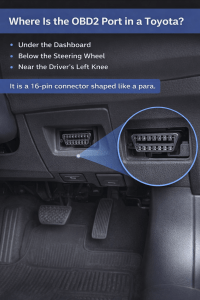
Where Is the OBD2 Port for a Toyota OBD2 Scanner?
In most Toyota models, the OBD2 port is located:
Under the dashboard
Below the steering wheel
Near the driver’s left knee
It is a 16-pin connector shaped like a trapezoid.
______________________________________________________________________________________________________________________________________
Common Toyota Trouble Codes
Here are common codes you may see when using a Toyota OBD2 scanner:
P0171 – System Too Lean
Often caused by:
Dirty Mass Air Flow (MAF) sensor
Vacuum leak
Faulty oxygen sensor
Related guide:
👉 Read our detailed breakdown of MAF issues here.
______________________________________________________________________________________________________________________________________
P0300 – Random Misfire Detected
Possible causes:
Worn spark plugs
Faulty ignition coils
Fuel injector problems
______________________________________________________________________________________________________________________________________
P0420 – Catalyst Efficiency Below Threshold
Common causes:
Failing catalytic converter
Faulty downstream O2 sensor
Related guide:
👉 Learn more about Toyota oxygen sensor.
______________________________________________________________________________________________________________________________________
P0100 – Mass Air Flow Circuit Malfunction
Typically caused by:
Dirty or failing MAF sensor
Wiring issue
______________________________________________________________________________________________________________________________________
Types of Toyota OBD2 Scanner Tools
1. Basic Code Readers
Reads and clears engine codes
Budget-friendly
Suitable for basic diagnostics
2. Bluetooth OBD2 Scanners
Connects to smartphone apps
Displays live sensor data
Good for DIY vehicle owners
3. Advanced Diagnostic Tools
Reads ABS and airbag codes
Transmission diagnostics
Suitable for advanced users
______________________________________________________________________________________________________________________________________
How to Use a Toyota OBD2 Scanner
Turn ignition to ON (engine off)
Plug scanner into OBD2 port
Select “Read Codes”
Record the code
Research before clearing
Do not clear codes before diagnosing the issue, as it may reset readiness monitors needed for emissions testing.
______________________________________________________________________________________________________________________________________
Can You Drive With the Check Engine Light On?
It depends on the condition:
Solid light: May be safe for short distances
Flashing light: Stop driving immediately
A flashing light often indicates a misfire that could damage the catalytic converter.
For official safety guidance, refer to your vehicle’s owner manual or consult your local Toyota dealer.
______________________________________________________________________________________________________________________________________
When Should You See a Mechanic?
You should seek professional inspection if:
The same code returns after clearing
The vehicle stalls or runs rough
ABS or airbag lights are illuminated
There is fuel smell or overheating
A Toyota OBD2 scanner helps identify the general area of concern but does not always confirm the exact failed component.
______________________________________________________________________________________________________________________________________
Benefits of Owning a Toyota OBD2 Scanner
Using a Toyota OBD2 scanner allows you to:
Identify issues early
Avoid unnecessary diagnostic fees
Monitor live engine data
Make informed repair decisions
For Toyota owners who perform basic maintenance, a scanner is a practical and useful tool.
Recommended Toyota OBD2 Scanner
If you’re looking for a reliable and easy-to-use option, you can check the current price and reviews for a popular Toyota-compatible OBD2 scanner here.
Leave a Reply